A few miles south of Palm Beach Island, in Manalapan, a buyer named David MacNeil closed on two adjacent oceanfront properties for a combined $94 million. One of the two homes had just been rebuilt. Both are now slated for demolition so MacNeil can build a single custom estate across nearly four acres running from the ocean to the Intracoastal.
That detail is worth sitting with. A home that was recently finished, presumably to a standard most buyers would call move-in perfect, is being knocked down anyway. Not because it was flawed. Because it wasn't the buyer's footprint.
Walk that logic north onto South Ocean Boulevard, the stretch known as Billionaire's Row, and the same pattern shows up in the pricing itself. Buyers here are not really shopping for houses. They're shopping for land that can hold whatever they decide to build next, and the market has started to price that distinction explicitly.
Three Prices on the Same Street
Look at what's actually traded and listed on Billionaire's Row over the past year and the spread tells its own story.
| Property | Status | Asking or Sale Price | What's actually being sold |
|---|---|---|---|
| 1980 South Ocean Boulevard | Vacant land, nearly two acres | $200 million | Ocean and Intracoastal frontage, one of only 20 sites on the island with both |
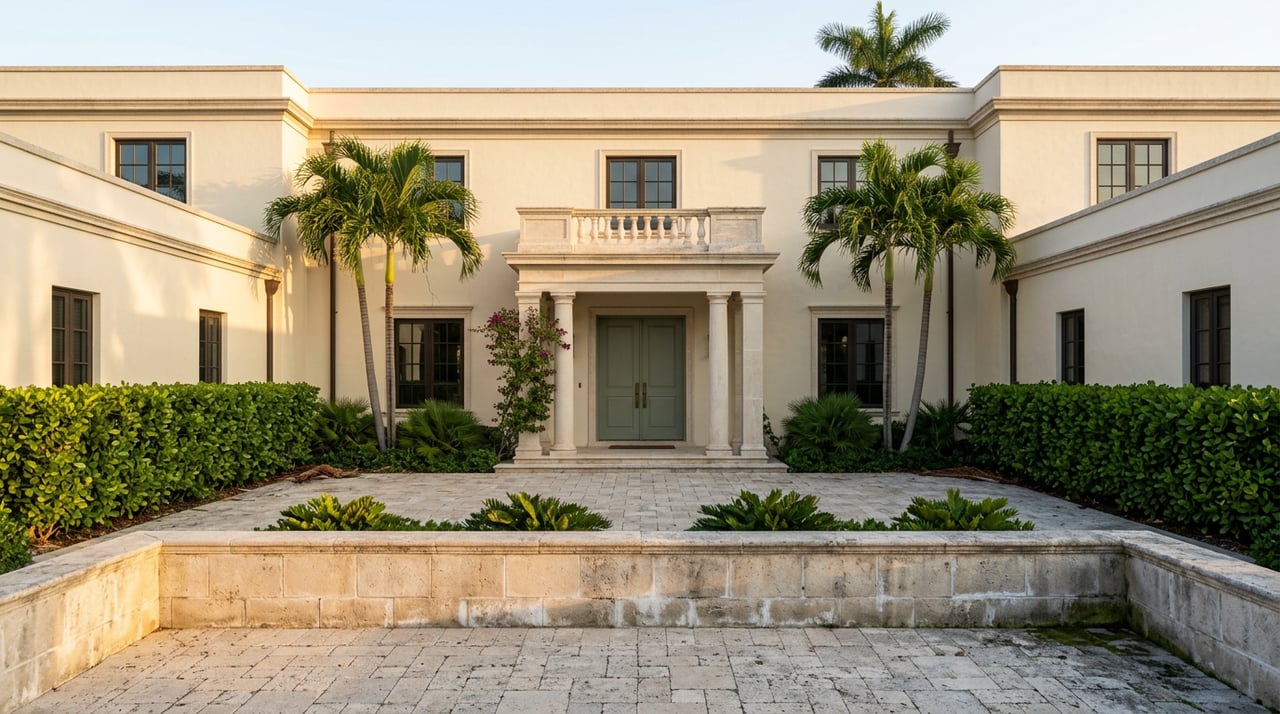
| 1540 South Ocean Boulevard | New spec-built compound, never occupied | $84.95 million (reduced from $88 million) | 16,500 square feet, a private tunnel to a beach cabana, and a 20.3-foot elevation that made a full basement possible |
| A South Ocean Boulevard estate | Updated, turnkey | $37 million | A dual-pool layout and finished interiors on a smaller parcel |
The vacant lot outprices the finished mega-mansion by more than two to one. That's not a story about square footage or finish quality. It's a story about what the dirt itself can support. The 1980 South Ocean Boulevard parcel is being marketed as one of the last sites on the island where a buyer could build ocean-to-Intracoastal without assembling multiple lots first, according to Robb Report's coverage of the listing. Scarcity of that specific configuration, not the absence of a house, is what the $200 million figure reflects.
Elevation Is the Line Item Nobody Photographs
The 1540 South Ocean Boulevard compound offers a clean look at why land quality outweighs finish level here. Its 20.3-foot elevation isn't a marketing footnote. It's what allowed the builders to dig a full basement level, complete with a wine cellar, game room, and a reinforced safe room, according to Dwell's coverage of the property. Most oceanfront lots on the island sit low enough that a basement of that scale simply isn't feasible.
That elevation number connects directly to Florida's flood zone rules. Properties along the immediate oceanfront typically fall into FEMA's Zone VE, the coastal high-hazard designation that requires breakaway walls and piling foundations because of wave action, not just standing water. Building in Zone VE costs meaningfully more than building in the more common Zone AE a few blocks inland, and a compromised seawall alone can add over $100,000 to a project before the foundation is even poured.
None of that shows up in a listing photo. It shows up in the buildable envelope: how high a foundation can sit, how much can go below grade, whether a basement is possible at all. On Billionaire's Row, that envelope is worth more than the drywall stacked on top of it.
Why Buyers Tear Down Rather Than Renovate
Elizabeth DeWoody was interviewed by the New York Times in July 2025 about exactly this dynamic, as major buyers like Oracle co-founder Larry Ellison moved to acquire waterfront teardowns on the island.
"This is not slowing down any time soon. Buyers want what they want and can get what they want. And sometimes what people want might change."
That last line is the operative one. A buyer with the capital to purchase on Billionaire's Row isn't constrained by what exists on a lot. They're constrained by what the lot allows. A finished home built to someone else's specifications, even a very good one, is often treated as a placeholder rather than a finished product. Elizabeth DeWoody's own coverage of the island's land rush points to Ellison's history here specifically: he previously paid $173 million for the island's famed Gemini estate before more recently acquiring another waterfront teardown near $50 million. The pattern isn't a one-time event. It's how the top of this market has started to operate.
The Island Can't Sprawl, So It Assembles
Part of why teardowns dominate instead of new construction on open land is straightforward. Palm Beach Island is effectively built out. There is no undeveloped frontage left to develop from scratch in most cases, so the only way to create a new large estate is to buy what's there and consolidate.
That pattern shows up elsewhere on the island too, not just on Billionaire's Row. On North Ocean Boulevard, near Mar-a-Lago, a buyer recently assembled four properties into a single 4.2-acre oceanfront estate for a combined $136 million, including two smaller residences purchased for $18 million and $30 million respectively that exist mainly to complete the footprint. Those two houses were not bought because someone wanted to live in them as-is. They were bought because they sat between the buyer and a contiguous parcel.
The lesson for a Billionaire's Row buyer isn't that assemblage will happen on this specific street. It's that the underlying constraint, a fully built-out island with almost no way to add new large lots except by consolidating existing ones, applies here just as much as it does a mile north. Scarcity of large, high-elevation, dual-frontage parcels is structural, not seasonal.
More Listings, Same Ceiling
Here's the part that looks contradictory until you separate what's actually for sale. Recent market commentary puts single-family inventory on Palm Beach Island up more than 50 percent even as $10 million-plus sales continue tracking near 2025's record pace, with median island home values estimated near $12.9 million.
More listings and record top-end pricing at the same time sounds like it shouldn't happen. It happens because a chunk of that added inventory isn't competing product for someone who wants to move into a finished trophy home. It's land, teardown candidates, and assemblage pieces, priced and marketed to a different kind of buyer entirely. A rising count of active listings doesn't soften demand for the handful of parcels that offer real elevation, real frontage, and real buildable capacity. If anything, a wider pool of mediocre or constrained lots makes the rare unconstrained one stand out more.
What This Means If You're Actually Comparing Properties
If you're evaluating anything on or near Billionaire's Row, square footage and finish level are the least useful numbers to lead with. A few questions matter more:
- What's the lot's elevation, and does it sit in FEMA Zone VE or the less restrictive Zone AE? That single distinction changes what can be built below grade and what flood insurance will cost every year afterward.
- Is there an elevation certificate on file? It's one of the more useful documents in a waterfront transaction file, and it should be requested early, not after inspections are underway.
- Does the parcel offer dual frontage, ocean and Intracoastal, or just one? Sites with both are genuinely rare on this stretch of the island.
- If the existing structure were removed entirely, what could actually be built in its place under current code? That answer, more than anything currently standing on the lot, is what you're pricing.
None of this replaces a walk-through or a conversation about lifestyle fit. But on a street where a vacant parcel can outprice a finished mansion by tens of millions of dollars, the land underneath deserves at least as much scrutiny as the kitchen.
A Few Questions Worth Asking Directly
Does a newer or recently renovated home always command a premium on Billionaire's Row? Not necessarily. Recent transactions show buyers purchasing newly built or newly renovated homes specifically to demolish them, because the buyer's intended footprint doesn't match what exists. Age and finish level matter less here than elevation and buildable capacity.
What is a buildable envelope, and why does it matter more than square footage? It's the combination of elevation, setbacks, and flood zone classification that determines what can legally and physically be constructed on a given lot, including whether a basement is feasible. Two lots of identical size can have very different buildable envelopes depending on where they sit relative to Base Flood Elevation.
Is Billionaire's Row the same as the Estate Section? No. Billionaire's Row refers specifically to the South Ocean Boulevard corridor, while the Estate Section is a separate, though nearby, part of the island with its own character and pricing dynamics.
Understanding what actually drives value on a street like this, rather than relying on comps built from square footage alone, is the difference between a confident offer and an expensive guess. If you're weighing a purchase or considering what your own Billionaire's Row property is truly worth in this environment, Elizabeth DeWoody can walk you through the land-specific factors that matter most before you make a move. Work With Elizabeth.